


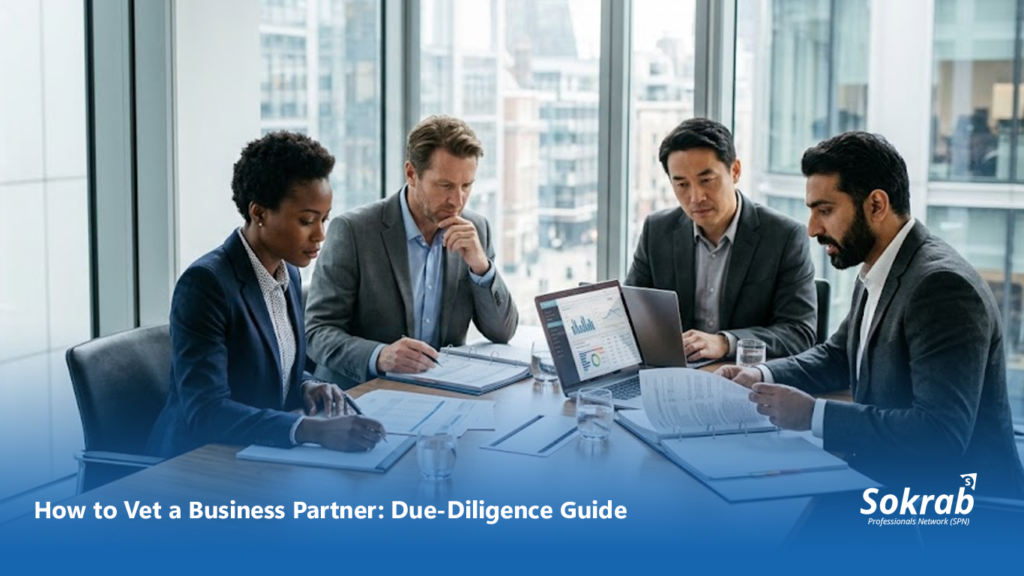
How to Vet a Business Partner: A Practical Due-Diligence Checklist
How to vet a business partner is a question every founder, investor, and firm faces before committing to a deal. A strong partner can accelerate your growth, while a weak or dishonest one can damage your finances and reputation. Fortunately, careful due diligence removes much of the guesswork. This guide gives you a practical checklist and shows how a trusted network reduces the risk of choosing the wrong partner.
We will cover why vetting matters, the exact checks to run, the red flags to watch for, and how professional networks make partner selection far safer.
Why Knowing How to Vet a Business Partner Protects You
A partnership ties your business to someone else’s decisions, reputation, and reliability. Because of this, due diligence is not a formality, it is protection. The time you invest upfront saves far more time, money, and stress later.
The Real Cost of a Bad Partner
A poor partner can trigger financial loss, legal disputes, missed deadlines, and reputational harm. Moreover, unwinding a bad relationship is often slow and expensive. Prevention, therefore, is always cheaper than the cure.
When Due Diligence Matters Most
Vetting is essential before joint ventures, supplier agreements, referrals, and cross-border deals. In each case, you rely on the other party to deliver as promised. Consequently, the higher the stakes, the deeper your checks should go.
Not sure a potential partner checks out? Connect only with verified, accountable professionals, backed by a network built on trusted introductions.
Join the Network →The Business Partner Due-Diligence Checklist
Knowing how to vet a business partner starts with a repeatable checklist so nothing slips through. The goal is simple: confirm that the partner is legitimate, financially sound, and reputable.
Verify Legal Status and Ownership
First, confirm the company is properly registered and identify who really owns and controls it. In addition, check licenses, permits, and any regulatory approvals relevant to the work. This establishes that you are dealing with a genuine, accountable entity.
Review Financial Health
Next, assess financial stability. Where available, review financial statements, credit standing, and payment history. A financially healthy partner is far more likely to honour commitments and weather difficult periods.
Check Reputation and References
Finally, speak to past clients, suppliers, and partners. Independent references reveal how the company behaves in practice. Tools such as the Transparency International corruption index also help you gauge country-level integrity risk.
How to Vet a Business Partner Across Borders
International partnerships add extra layers to consider. Different legal systems, languages, and standards can hide risks that domestic checks would catch. Therefore, cross-border vetting needs extra care.
Navigate Different Legal Systems
Rules on contracts, ownership, and dispute resolution vary widely between countries. As a result, local legal insight is invaluable. Expert business advisory support helps you interpret documents and structure agreements correctly.
Watch for Compliance and Sanctions Red Flags
Screen partners against sanctions lists, anti-money-laundering requirements, and reputational databases. This protects you from legal exposure and from association with bad actors. When in doubt, seek specialist compliance advice.
Red Flags You Should Never Ignore
Some warning signs appear early. Learn to recognise them, and trust your judgment when something feels off.
Inconsistent or Evasive Information
Be cautious if a partner avoids direct questions, delays sharing documents, or gives inconsistent answers. Transparency is a foundation of trust, so its absence is a serious concern.
Pressure and Unrealistic Promises
Similarly, high-pressure tactics and results that sound too good to be true often signal trouble. Reliable partners are confident but honest about risks and timelines.
How a Professional Network De-Risks Partner Selection
Vetting is far easier when you start with pre-screened candidates. In fact, the simplest answer to how to vet a business partner is to begin inside a trusted network, because it beats open platforms for high-stakes decisions.
Vetted Members and Verified Credentials
In a trusted network, members are already screened, which raises the baseline quality of every introduction. You can explore this advantage in our comparison of a vetted professional network versus open platforms. To see the range of expertise available, review the network’s areas of expertise.
Warm Introductions and Accountability
Because introductions come with reputational accountability, members have a strong incentive to act with integrity. As a result, you begin every partnership from a position of greater trust and lower risk.
Conclusion
Knowing how to vet a business partner is one of the most valuable skills in business. A disciplined checklist covering legal status, financial health, reputation, and compliance protects your capital and your name. Cross-border deals demand even greater care, and clear warning signs should never be ignored. Above all, starting with a vetted network gives you a powerful head start on trust.
Want to partner with confidence? Join the Sokrab Professional Network and connect with vetted professionals and firms, backed by verified credentials and accountable introductions.
Free Download
Get the 12-Point Partner-Vetting Checklist
The practical due-diligence checklist our advisors use — verify legal status, finances, reputation, compliance, and red flags before you sign. Enter your email and we’ll send it straight to you.
No spam. We’ll only use your email to send the checklist and occasional network updates. Unsubscribe anytime.
Frequently Asked Questions About Vetting a Business Partner
Below are answers to the questions professionals ask most about due diligence and partner selection. These FAQs cover the vetting process, documents to request, red flags, cross-border checks, and how the Sokrab Professional Network (SPN) reduces partnership risk.
1. How do you vet a potential business partner?
Run a consistent due-diligence process: verify legal registration and ownership, review financial health, check references and reputation, and screen for compliance and sanctions risks. For cross-border deals, add local legal and cultural insight to catch risks that standard checks miss.
2. What documents should I request when vetting a business partner?
Request the business registration and licenses, ownership and director details, recent financial statements, relevant permits, and references from past clients or partners. For international deals, ask for documents that confirm legal standing in the partner's home jurisdiction.
3. What are the biggest red flags in a business partner?
Warning signs include evasive or inconsistent answers, reluctance to share documents, high-pressure tactics, and promises that sound too good to be true. Any lack of transparency around ownership, finances, or track record should prompt deeper investigation.
4. How do I vet an international business partner?
Apply your standard checklist, then add cross-border layers: understand the local legal system, verify credentials in the partner's jurisdiction, screen against sanctions and anti-money-laundering lists, and seek local legal and advisory support to interpret documents correctly.
5. How does the Sokrab Professional Network help vet business partners?
The Sokrab Professional Network (SPN) pre-screens its members, so you start from a higher baseline of trust. Introductions carry reputational accountability, and members can access advisory support to complete deeper due diligence when the stakes are high.
Choose the Right Partners With Confidence
Every strong business is built on reliable partnerships, and every reliable partnership starts with disciplined due diligence. Verifying legal status, financial health, reputation, and compliance protects your company from avoidable losses and lets you commit with confidence.
Through the Sokrab Professional Network (SPN), you connect with pre-screened professionals and firms, backed by verified credentials and accountable introductions. Whether you are choosing a supplier, a referral partner, or a joint-venture ally, SPN helps you start from a position of trust.
Ready to Partner With Confidence?
Join the Sokrab Professional Network and connect with vetted professionals and firms across global markets. Reduce partnership risk, access trusted introductions, and build relationships that stand the test of time.
Join the Network Today →Written by
Sokrab Advisory Team
The Sokrab Advisory Team is part of the Sokrab Professional Network (SPN), a global alliance of vetted professionals and firms spanning the UAE, China, Rwanda, the United Kingdom, and beyond. The team helps businesses with cross-border market entry, trusted partner introductions, due diligence, and investor connections.
Join the Network →Recent Posts

Sokrab Professionals Network (SPN): A Leading Professional Networking Platform for Global Experts and Business Growth
November 28, 2025
No Comments

Professional Opportunities: Connect, Collaborate, and Grow Globally
December 17, 2025
No Comments
Join Us
Choose Your Category
×
